

As businesses enter 2026, the pace of technological disruption is accelerating faster than even the most ambitious CIOs anticipated. AI has become pervasive, cloud infrastructure is evolving into something entirely new, cyber-risk is reshaping boardroom strategy, and digital productivity tools are undergoing the biggest shift since the invention of SaaS.
Based on industry momentum, spending patterns, and emerging capabilities across enterprise software, here are the top business-technology predictions for 2026 – and what they mean for IT, security and operations leaders.
1. AI Becomes Fully Autonomous in Business Workflows
2025 was the year organisations embraced copilots, assistants and LLM-powered productivity tools. But 2026 is the year AI shifts from assistant to autonomous operator.
Instead of suggesting actions, AI will execute full workflows across HR, finance, operations, logistics, and cybersecurity.
Examples include:
Auto-generated financial reports, fully reconciled and audit-ready
HR onboarding workflows triggered, executed and closed without human touch
Security events triaged, contained and remediated by AI-driven SOC operators
Supply-chain delays automatically rerouted using predictive AI models
Humans won’t disappear – their roles will shift to supervisors, reviewers and strategy owners.
Why it matters: companies that don’t adopt automation risk falling behind competitors with 40–60% lower operational overhead.
2. Identity Becomes the New Cyber “Perimeter”
Cybersecurity teams are realising that traditional perimeter, endpoint and application security aren’t enough as identity-based attacks skyrocket.
In 2026:
Identity Threat Detection & Response (ITDR) becomes mandatory, not optional
Unified identity + endpoint + cloud analytics platforms replace fragmented tools
Zero Trust becomes less of a buzzword and more of a monitor-everything model
SaaS bloat, remote working, and third-party integration risk will force companies to converge identity systems across applications, devices and cloud services.
Why it matters: attackers increasingly bypass firewalls and go straight for identities.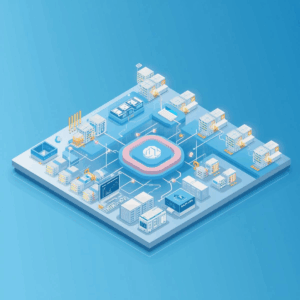
3. Multi-Cloud Evolves Into “Distributed Cloud Fabric”
Multi-cloud complexity has reached a breaking point. In 2026, we will see the rise of distributed cloud fabric – cloud platforms operating as a single logical environment across AWS, Azure, private cloud and edge.
Workloads won’t be moved between clouds. They will be dynamically orchestrated based on latency, cost or risk.
Expect:
One-click portability
Unified observability
Centralised compliance controls
Portable zero-trust identity
Why it matters: distributed cloud lets enterprises break out of vendor lock-in while reducing infrastructure risk.
4. Operational Technology (OT) & IT Finally Converge
 Manufacturing, logistics and critical-infrastructure sectors will see a merging of IT systems (SaaS, identity, cloud) with OT systems (SCADA, industrial machinery, robotics).
This means:
Shared identity across factory floor and SaaS apps
Predictive maintenance driven by AI
Digital twins of entire factories
Unified cybersecurity for both digital and physical assets
Why it matters: convergence boosts uptime, enhances safety and reduces risk – but also creates new cyber-exposure that companies must secure.
5. Platform Consolidation Begins: Fewer Tools, More Capability
2026 is the year tool sprawl becomes unsustainable.
Businesses will replace:
❌ 10+ security tools
❌ Fragmented SaaS stacks
❌ Multiple data warehouses
❌ Disconnected HR, finance and IT platforms
With:
✅ Unified security platforms
✅ End-to-end business suites
✅ All-in-one data ecosystems
✅ Cross-department automation engines
This reduces complexity, licensing costs and integration overhead – a priority as budgets tighten.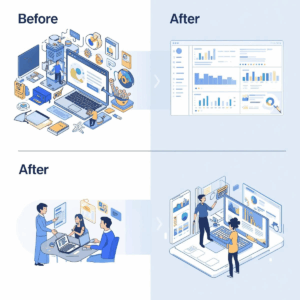
6. AI-Driven Personalisation Reaches Every Department
Marketing teams already use AI targeting, but in 2026:
HR personalises learning paths
Finance personalises budget recommendations
IT personalises access, alerts and software usage
Customer service personalises automated support flows
Why it matters: companies with personalised workflows report 20-40% higher productivity and engagement.
7. SMBs Embrace Enterprise-Grade Tech at Scale
2026 is the year where advanced tools – SOC services, unified security, AI automation, advanced PLM/PDM, ERP extensions – become cost-accessible to SMBs.
Thanks to AI-powered managed platforms, small businesses will deploy:
AI SOCs
Fully automated HR/Payroll
AI-augmented ERP systems
Unified backup and cybersecurity platforms
Why it matters: becoming “enterprise-capable” allows SMBs to compete globally.